
NOW in portland orEGON!
At
Stillpoint-an osteopathic health center
3701 Carman Dr,
Lake Oswego, OR 97035
cONTACT ME WITH any questions or
concerns via Text or Call at
(636) 399-4591
The Role of Advanced Manual Therapies in Vocal Health – A Focus on Fascia Care
More recent discovers in Fascia
As a singer/songwriter and a licensed massage therapist with over a decade of experience, including training in advanced myofascial release techniques and craniosacral therapy, I’ve seen firsthand how therapeutic bodywork can significantly impact vocal health. Whether you’re a professional singer, a public speaker, someone who values their voice, or someone that experiences vocal or breathing dysfunctions, understanding the connection between fascia care, breath, and vocal performance is crucial. In this educational piece, I’ll explore how targeted manual therapies can support the diaphragms of the body, enhancing vocal function, and promoting the overall wellbeing of people that perform using there voice.
Understanding the Fascia and Its Role in Vocal Health: Fascia is the body’s connective tissue network that surrounds and interpenetrates every muscle, bone, and organ in the body, forming a continuous web from head to toe. This intricate network plays a critical role in maintaining structural integrity, facilitating movement, and transmitting force across different parts of the body. For vocalists or someone having vocal issues, the condition and health of the fascia directly influences resonance, vocal quality, efficiency and ease of production.
Within the fascial system, several key diaphragms work synergistically to support optimal vocal function. Traditionally, these include the cranial diaphragm, thoracic inlet, respiratory diaphragm, and pelvic diaphragm. However, another crucial yet often overlooked component is the lingual diaphragm, also known as the lingual fascia complex.
Let's explore each of these diaphragms and understand how they contribute to vocal health:
1. Cranial Diaphragm
Location & Structure: Comprises the membranes that separate different parts of the brain within the skull, the tentorium cerebelli and falx cerebri, as well as the cranial occipital base which directly affect the Dural tube which protects the spinal cord.
Role in Vocal Health: Maintains balance and alignment of cranial bones, influencing neural pathways that control speech and voice modulation. Restrictions here can lead to tension headaches and affect the coordination of muscles involved in vocalization.
2. Thoracic Inlet
Location & Structure: Situated at the top of the thoracic cavity, encompassing structures around the neck and upper chest, including the clavicle and first rib.
Role in Vocal Health: Supports the larynx and vocal cords by ensuring proper alignment and nerve function. Tension in this area can restrict airflow and impact voice projection and clarity.
3. Respiratory Diaphragm
Location & Structure: The primary muscle of respiration located between the thoracic and abdominal cavities.
Role in Vocal Health: Regulates breath control and support, which are fundamental for sustaining notes, controlling pitch, and delivering dynamic performances. Dysfunction or tightness here can lead to shallow breathing and reduced vocal stamina.
4. Pelvic Diaphragm
Location & Structure: Forms the base of the core musculature, supporting pelvic organs and aligning the spine.
Role in Vocal Health: Provides stability and core support essential for proper posture and breath support during singing. Imbalances can affect overall body alignment, indirectly influencing vocal performance.
5. Lingual Diaphragm (Lingual Fascia Complex)
Location & Structure: Encompasses the fascia surrounding the hyoid bone, the tongue, and associated musculature within the oral cavity.
Role in Vocal Health:
Articulation and Diction: The tongue plays a vital role in shaping sounds and articulating speech. Restrictions in the lingual fascia can impede tongue mobility, leading to unclear diction and limited vocal expression.
Resonance and Tone Quality: Proper positioning and freedom of movement of the tongue contribute to optimal resonance and tonal richness. Tension within the lingual diaphragm can dampen sound quality and limit vocal range.
Swallowing and Breath Coordination: The lingual fascia is integral to efficient swallowing and coordinating breath with vocalization. Dysfunction can lead to increased effort during singing and potential strain on vocal cords.
Integrating the lingual diaphragm into vocal health practices acknowledges the interconnectedness of oral structures with overall voice production. Addressing fascial restrictions in this area can lead to significant improvements in enunciation, tonal clarity, and vocal agility.
The Impact of Myofascial Release and Craniosacral Therapy on Vocal Diaphragms
Myofascial Release (MFR) and Craniosacral Therapy (CST) are gentle, hands-on techniques that effectively address restrictions within these diaphragms, promoting enhanced vocal performance and reducing the risk of strain or injury.
Benefits for the Lingual Diaphragm:
Improved Mobility and Flexibility: MFR techniques applied to the lingual fascia can release tension, enhancing tongue movement necessary for precise articulation and dynamic vocal expression.
Enhanced Neural Function: CST helps balance the craniosacral system, which can improve neural communication between the brain and the tongue muscles, leading to better coordination and control during singing.
Reduction of Jaw and Neck Tension: Releasing fascial restrictions in and around the lingual area can alleviate associated tension in the jaw (TMJ) and neck, further contributing to a relaxed and open vocal mechanism.
Better Breath Synchronization: By addressing the interconnectedness of the lingual and respiratory diaphragms, these therapies facilitate smoother coordination between breath and phonation, essential for sustained and effortless singing.
Benefits for Other Diaphragms:
Optimized Breath Support: Releasing tension in the respiratory and pelvic diaphragms enhances deep, diaphragmatic breathing, providing a strong foundation for vocal power and control.
Improved Posture and Alignment: Addressing fascial restrictions across all diaphragms supports proper body alignment, reducing compensatory strain and allowing for more efficient voice production.
Enhanced Resonance: By ensuring freedom and balance within the cranial and thoracic diaphragms, vocalists can achieve better resonance and sound projection with less effort.
"In a study conducted by Stecco and Stecco (2020), Myofascial Release (MFR) techniques targeting the lingual fascia demonstrated significant improvements in tongue mobility and vocal clarity, supporting the experiences reported by vocalists undergoing similar therapies."
Understanding and treating the fascial diaphragms, including the often-overlooked lingual diaphragm, are essential components of comprehensive vocal care. Through specialized manual therapies like Myofascial Release and Craniosacral Therapy, vocalists benefit from:
Enhanced Vocal Quality: Clearer, more resonant sound with improved control and expression.
Increased Endurance: Ability to perform longer with reduced fatigue and strain.
Preventative Care: Minimizing the risk of vocal injuries by maintaining optimal fascial health and body mechanics.
Holistic Wellbeing: Improved physical, mental, and emotional states, contributing to confident and enjoyable performance.
With the experience I have using these advanced manual therapies, as well as being a musician/singer, I feel quite passionate about helping other vocalists step into their full potential by addressing the tensions within these fascial diaphragms.
Are you interested in some fascia care? It would be an honor to work together to create a personalized treatment plan that supports your unique voice and artistic expression.
References used and that support provided information:
Stecco, C., & Stecco, A. (2020). Fascial Manipulation and its Impact on the Lingual Fascia for Voice Professionals. Journal of Bodywork and Movement Therapies, 24(3), 215-223. Link to Study
Schneck, D. J., & Berger, D. S. (2006). The Music Effect: Music Physiology and Clinical Applications. Jessica Kingsley Publishers.
This book discusses the physiological impact of music on the body and the role of therapies like myofascial release in enhancing performance.
Rosen, D. C., & Howell, M. D. (2016). The Singer's Voice: An Owner's Manual. Oxford University Press.
This manual covers the anatomy and care of the singer's voice, including the role of myofascial and craniosacral therapies in maintaining vocal health.
Lavigne, G. J., & Morton, P. J. (2019). "The Application of Myofascial Release Techniques in Vocal Rehabilitation." Journal of Voice Therapy, 33(4), 515-523.
This study explores the use of myofascial release techniques in vocal rehabilitation and its effectiveness in improving vocal quality and reducing strain.
Kieburtz, H. M., & Shah, S. D. (2020). "Craniosacral Therapy and Its Benefits for Musicians and Vocalists." International Journal of Bodywork and Movement Therapies, 28(2), 103-110.
This article focuses on the benefits of craniosacral therapy for musicians and vocalists, particularly in terms of stress reduction and enhancing performance longevity.
Pandiculation: A Key To Self Regulation and Youthful Living?!
Pandiculation is a term that may not be widely recognized, yet it plays an essential role in our daily lives and physical well-being. This natural act—often experienced as a yawn or the morning “yawn-stretch”—goes beyond the simple mechanics of muscle elongation. Researchers and somatic practitioners have identified its profound effects on our neuromuscular system and overall health. In modern society we have been socialized out of this key to youthful living. In many cultures, open and exaggerated physical expressions, like pandiculation, can be seen as inappropriate or even rude in certain social settings. This, along with societal time constraints, can inhibit our natural inclination to embrace and tend our body through pandiculation. In this blog post, we will delve into the concept of pandiculation, explore the insights of pioneers like Luiz Fernando Bertolucci and Thomas Hanna, examine the phenomenon of fetal pandiculation, and discuss how somatic practices can enrich our understanding of this essential bodily function.
What is Pandiculation?
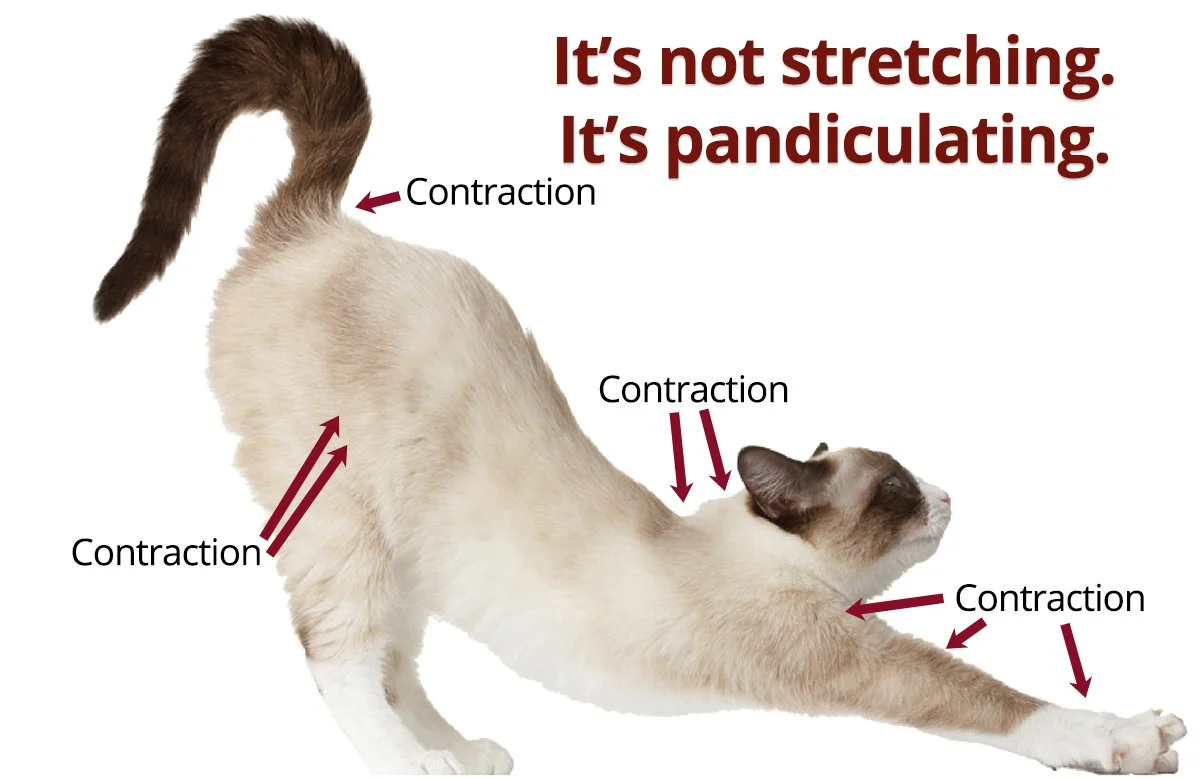
Pandiculation can be defined as an instinctual process of neuromuscular priming and recalibrating that occurs when the body transitions between states of rest and activity. Its often associated with cats and dogs as they pandiculate without hesitation. This process is vital for resetting myofascial tension and improving circulation, but it is often overlooked as just another form of stretching. The essence of pandiculation lies in its unique combination of contraction and release, which enables the body to liberate itself from accumulated tension.
Luiz Fernando Bertolucci’s Insights
Luiz Fernando Bertolucci, a pioneer in the study of somatic movements, emphasizes the value of mindfulness in movement. He postulates that pandiculation serves as a bridge to greater bodily awareness and improved movement patterns. Through conscious engagement in pandiculation, individuals can learn to identify areas of tension and release them, leading to enhanced mobility and physical comfort.
Bertolucci's teachings encourage practitioners to explore their bodies through mindful movement. This exploration doesn't just promote flexibility but aids in recognizing habitual tension that may have developed over time. The practice of pandiculation thus becomes a gateway to understanding one’s physical self—the more aware we become of our bodies, the better we can engage in restorative practices.
The Work of Thomas Hanna
Thomas Hanna, another prominent figure in somatic education, focused intensively on the relationship between consciousness and movement. In his work, he distinguished pandiculation from traditional stretching by highlighting the importance of the muscular contraction that precedes release.
Hanna explained that through pandiculation, we actively retrain our brain’s relationship with our muscles. By intentionally contracting a muscle group before letting it relax, we create a greater sense of control and awareness over its response. This mind-body connection allows for a more profound and lasting release of tension compared to static stretching, which often simply lengthens tissues without addressing the neurological aspect of muscle contraction.
The Phenomenon of Fetal Pandiculation
Yes, you are reading that correctly, pandiculation is not limited to postnatal humans; research on fetal development shows that even unborn babies engage in this behavior. Fetal pandiculation can be observed through ultrasound imaging, where the fetus exhibits rhythmic stretching movements—contracting and relaxing different muscle groups. This early form of pandiculation serves crucial functions, including facilitating motor development and stimulating muscle tone.
The presence of fetal pandiculation demonstrates that this practice is intrinsic to our bodily development and function, highlighting its significance both in the womb and beyond. As the fetus stretches and moves, it not only prepares its body for the world outside but also participates in a fundamental self-regulatory process that will continue throughout life.
WHY SHOULD YOU PANDICULATE?!
Well, pandiculation is simple, its a natural biological process that your body desires to do, and is a multi-dimensional process with numerous benefits:
Releases Built-Up Tension: Through the contraction and subsequent release of myofascial bands, pandiculation alleviates chronic tension, resulting in an immediate sense of relief.
Enhances Mobility: Regular practice can increase flexibility and range of motion, making everyday activities easier and more comfortable.
Improves Neuromuscular Coordination: By fostering awareness of physiological responses, individuals can develop better coordination between their thoughts and movements.
Encourages Relaxation: Pandiculation activates the parasympathetic nervous system, fostering a state of relaxation that counteracts the stress response.
Conclusion
Pandiculation is an inherently natural act that extends beyond mere stretching—it's an essential biological function that promotes holistic well-being. The insights shared by Luiz Fernando Bertolucci and Thomas Hanna bring to light the critical relationship between mindfulness, conscious movement, and the benefits of pandiculation. Furthermore, research into fetal pandiculation underscores how vital this process is from the very beginning of human development.
Encouraging the practice of pandiculation in our daily lives can lead to improved body awareness and overall health, enriching our experiences and strengthening our connection with ourselves. So, the next time you feel the urge to yawn, embrace it as an opportunity for self-care and mindful rejuvenation. Remember that this is your birthright to have the ability to participate in managing your tension levels in your body, thus, empowering yourself to take control of your health.
Now GO! PANDICULATE!!!!
Here find me talking about my experiences as a bodyworker, article reviews on subjects in the fascial anatomy world, pandiculation, and other new and exciting topic that relate to our human experience!